
Strategy Buys Back $139 Million in STRC Shares, Bitcoin Stack Stays Put
Sept. 14, 2026 — Bitcoin treasury firm Strategy (MSTR) spent roughly $139.3 million buying back 1.42 million shares of its STRC preferred stock between September 8 and September 13, the company disclosed in an 8-K filing with the SEC on Monday.
The repurchases were funded out of Strategy’s USD Cash reserve. As of September 14, that reserve held $1.3 billion, while the broader USD Reserve stood at $5.1 billion.
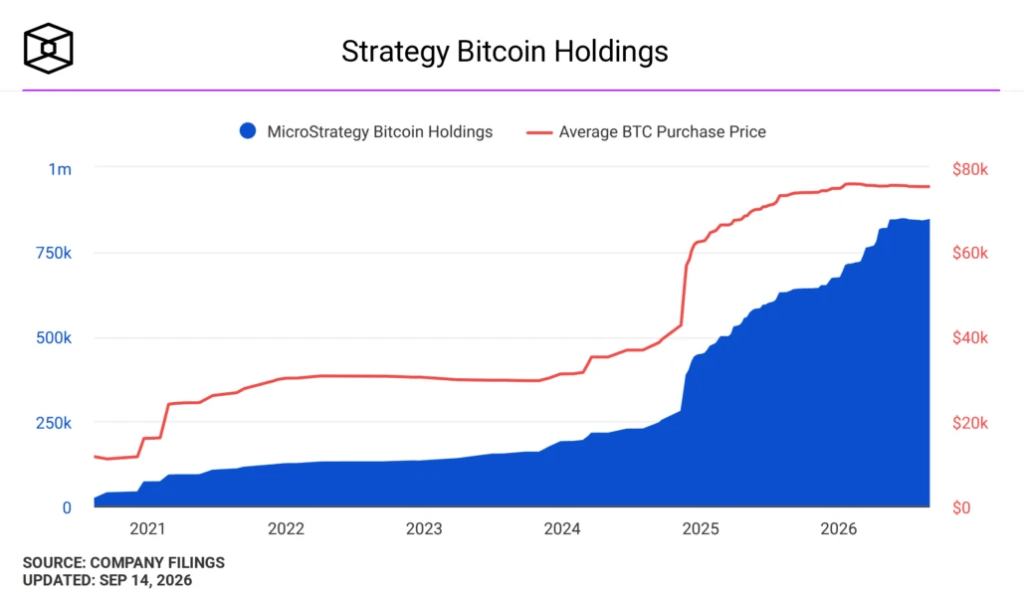
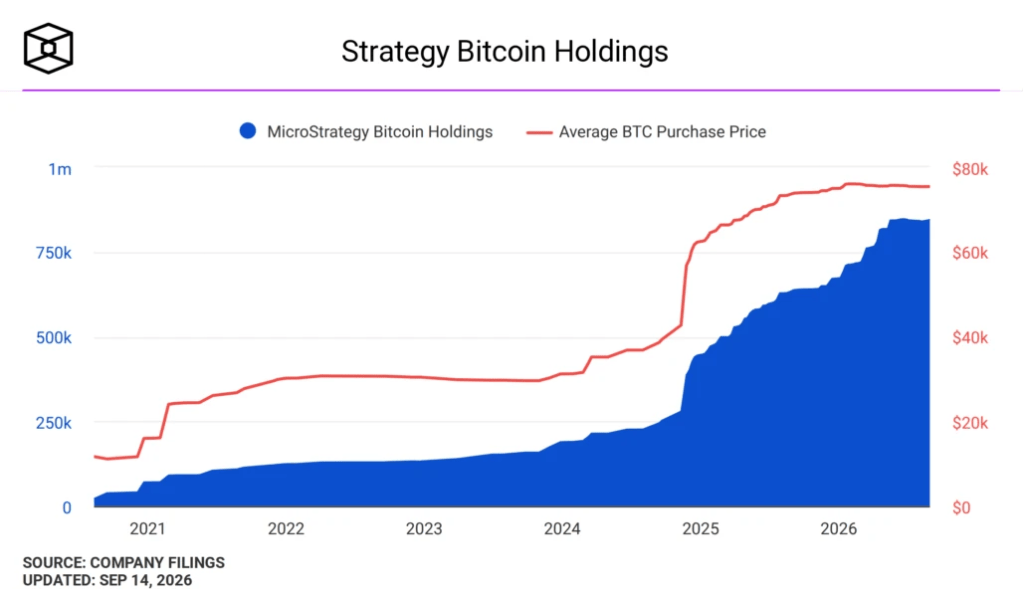
Bitcoin holdings, meanwhile, didn’t move. Strategy neither bought nor sold BTC last week, keeping its total at 845,050 coins — worth about $65.7 billion at current prices — for the second consecutive week.
That stash still represents more than 4% of bitcoin’s fixed 21 million supply. At an average cost basis of $75,412 per coin and a total outlay of $63.7 billion, the position currently sits on roughly $2 billion in unrealized gains.
A Quieter Cadence
Executive Chairman Michael Saylor has gone quiet on his usual Sunday bitcoin-tracker posts, a ritual that once served as an informal heads-up for upcoming purchases. The pause tracks with a broader shift in the company’s approach — one that’s leaned more toward steady holdings than active accumulation in recent weeks.
That shift ties back to Strategy’s newly adopted Digital Credit Capital Framework, which narrows the USD reserve’s purpose to covering preferred-stock dividends and interest payments. Under the same framework, the company greenlit a $1 billion buyback program for its digital credit securities — STRC first in line — before doubling that authorization to $2 billion last week.
Strategy has also cleared a separate $1 billion buyback for its common stock, and widened its BTC Monetization Program so that up to $5 billion in bitcoin sales can be tapped to cover reserve funding, dividend and interest obligations, and securities repurchases under the framework.
Where Strategy Sits in the Pack
Strategy remains the largest of 197 public companies now running some form of bitcoin treasury strategy, per Bitcoin Treasuries data. Rounding out the top five are Tether-backed Twenty One, Metaplanet, MARA, and Bitcoin Standard Treasury Company (backed by Adam Back and Cantor Fitzgerald), holding 43,514, 43,000, 35,577, and 30,021 BTC respectively.
Across the board, these bitcoin-holding companies remain well off their 2025 highs as their premiums over net asset value have compressed sharply. MSTR itself trades about 71% below its peak, with an enterprise mNAV of just 1.1, according to company figures.
Strategy shares slid 4.7% over the past week to close Friday at $130.97, while bitcoin itself fell 3.9% over the same stretch.Strategy Buys Back $139 Million in STRC Shares, Bitcoin Stack Stays Put
Sept. 14, 2026 — Bitcoin treasury firm Strategy (MSTR) spent roughly $139.3 million buying back 1.42 million shares of its STRC preferred stock between September 8 and September 13, the company disclosed in an 8-K filing with the SEC on Monday.
The repurchases were funded out of Strategy’s USD Cash reserve. As of September 14, that reserve held $1.3 billion, while the broader USD Reserve stood at $5.1 billion.
Bitcoin holdings, meanwhile, didn’t move. Strategy neither bought nor sold BTC last week, keeping its total at 845,050 coins — worth about $65.7 billion at current prices — for the second consecutive week.
That stash still represents more than 4% of bitcoin’s fixed 21 million supply. At an average cost basis of $75,412 per coin and a total outlay of $63.7 billion, the position currently sits on roughly $2 billion in unrealized gains.
A Quieter Cadence
Executive Chairman Michael Saylor has gone quiet on his usual Sunday bitcoin-tracker posts, a ritual that once served as an informal heads-up for upcoming purchases. The pause tracks with a broader shift in the company’s approach — one that’s leaned more toward steady holdings than active accumulation in recent weeks.
That shift ties back to Strategy’s newly adopted Digital Credit Capital Framework, which narrows the USD reserve’s purpose to covering preferred-stock dividends and interest payments. Under the same framework, the company greenlit a $1 billion buyback program for its digital credit securities — STRC first in line — before doubling that authorization to $2 billion last week.
Strategy has also cleared a separate $1 billion buyback for its common stock, and widened its BTC Monetization Program so that up to $5 billion in bitcoin sales can be tapped to cover reserve funding, dividend and interest obligations, and securities repurchases under the framework.
Where Strategy Sits in the Pack
Strategy remains the largest of 197 public companies now running some form of bitcoin treasury strategy, per Bitcoin Treasuries data. Rounding out the top five are Tether-backed Twenty One, Metaplanet, MARA, and Bitcoin Standard Treasury Company (backed by Adam Back and Cantor Fitzgerald), holding 43,514, 43,000, 35,577, and 30,021 BTC respectively.
Across the board, these bitcoin-holding companies remain well off their 2025 highs as their premiums over net asset value have compressed sharply. MSTR itself trades about 71% below its peak, with an enterprise mNAV of just 1.1, according to company figures.
Strategy shares slid 4.7% over the past week to close Friday at $130.97, while bitcoin itself fell 3.9% over the same stretch.Sept. 14, 2026 — Bitcoin treasury firm Strategy (MSTR) spent roughly $139.3 million buying back 1.42 million shares of its STRC preferred stock between September 8 and September 13, the company disclosed in an 8-K filing with the SEC on Monday.
The repurchases were funded out of Strategy’s USD Cash reserve. As of September 14, that reserve held $1.3 billion, while the broader USD Reserve stood at $5.1 billion.
Bitcoin holdings, meanwhile, didn’t move. Strategy neither bought nor sold BTC last week, keeping its total at 845,050 coins — worth about $65.7 billion at current prices — for the second consecutive week.
That stash still represents more than 4% of bitcoin’s fixed 21 million supply. At an average cost basis of $75,412 per coin and a total outlay of $63.7 billion, the position currently sits on roughly $2 billion in unrealized gains.
A Quieter Cadence
Executive Chairman Michael Saylor has gone quiet on his usual Sunday bitcoin-tracker posts, a ritual that once served as an informal heads-up for upcoming purchases. The pause tracks with a broader shift in the company’s approach — one that’s leaned more toward steady holdings than active accumulation in recent weeks.
That shift ties back to Strategy’s newly adopted Digital Credit Capital Framework, which narrows the USD reserve’s purpose to covering preferred-stock dividends and interest payments. Under the same framework, the company greenlit a $1 billion buyback program for its digital credit securities — STRC first in line — before doubling that authorization to $2 billion last week.
Strategy has also cleared a separate $1 billion buyback for its common stock, and widened its BTC Monetization Program so that up to $5 billion in bitcoin sales can be tapped to cover reserve funding, dividend and interest obligations, and securities repurchases under the framework.
Where Strategy Sits in the Pack
Strategy remains the largest of 197 public companies now running some form of bitcoin treasury strategy, per Bitcoin Treasuries data. Rounding out the top five are Tether-backed Twenty One, Metaplanet, MARA, and Bitcoin Standard Treasury Company (backed by Adam Back and Cantor Fitzgerald), holding 43,514, 43,000, 35,577, and 30,021 BTC respectively.
Across the board, these bitcoin-holding companies remain well off their 2025 highs as their premiums over net asset value have compressed sharply. MSTR itself trades about 71% below its peak, with an enterprise mNAV of just 1.1, according to company figures.
Strategy shares slid 4.7% over the past week to close Friday at $130.97, while bitcoin itself fell 3.9% over the same stretch.
 FinancialNewshub
Leave a comment